
Kanji Detective
iPhone · iPad
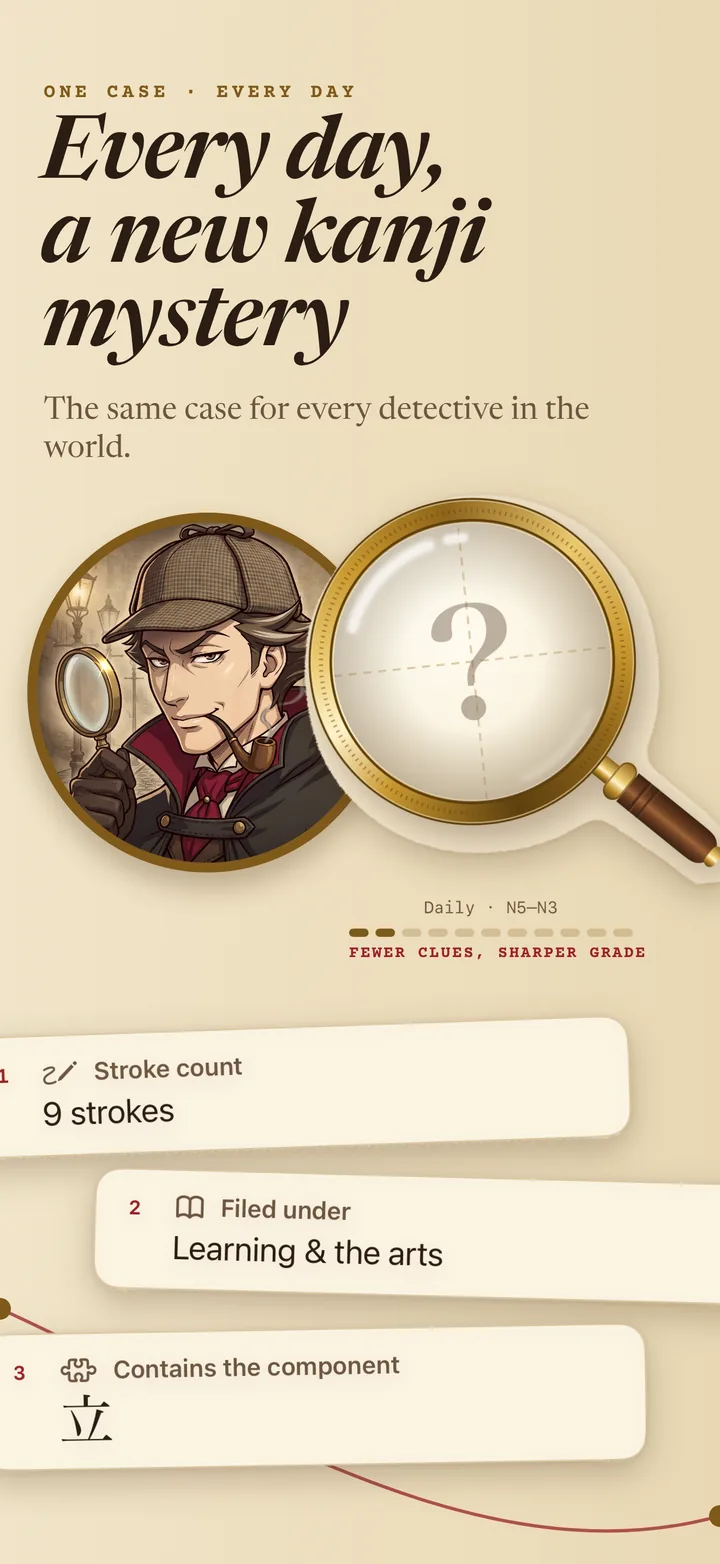
Every day,
a new kanji mystery.
One hidden kanji a day, the same for every detective in the world. Question suspects, follow the clues and name the culprit — then open the case file and really learn it. For iPhone and iPad.
Free daily case · Plus is a one-time purchase
- JLPT N5 → N1
- Works offline
- No ads, no account

What it does
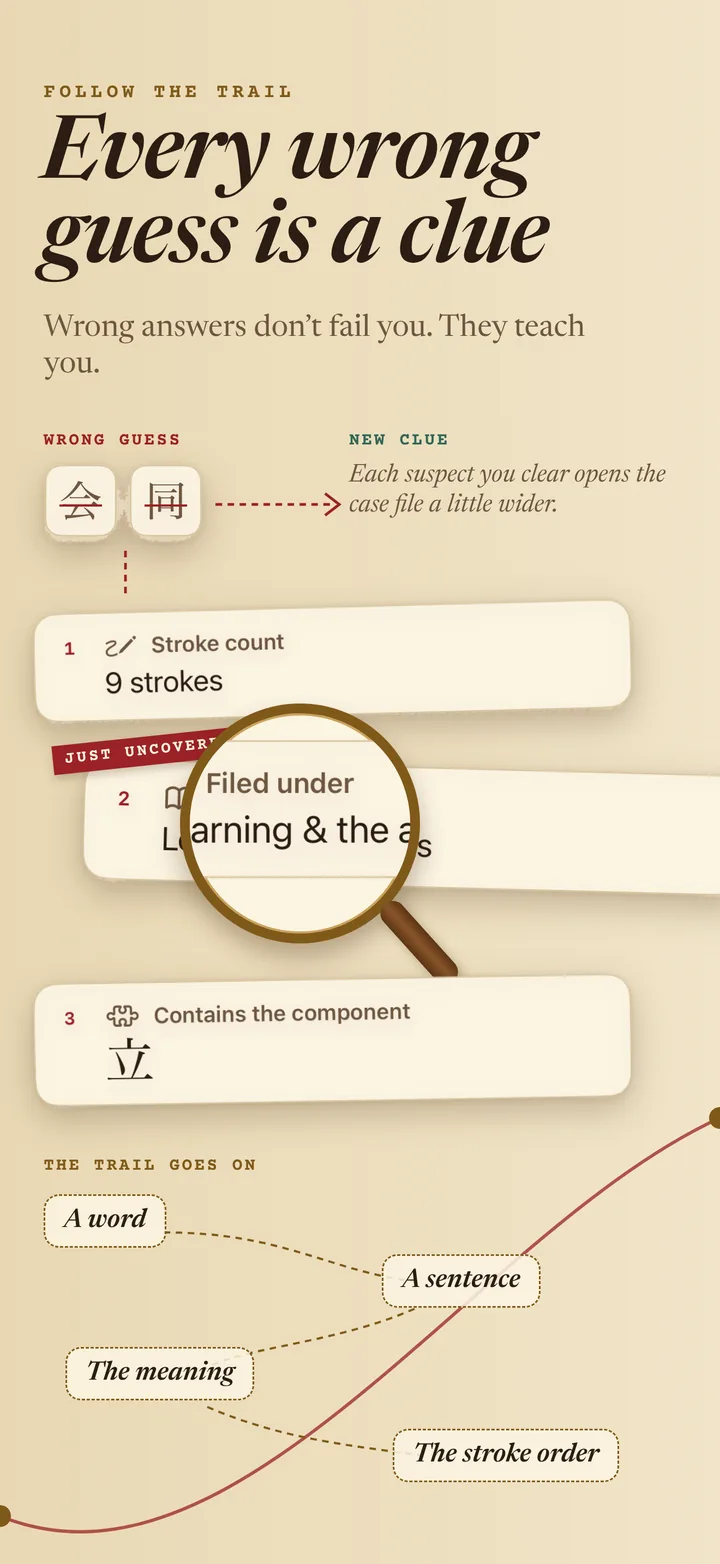
Every wrong guess is a clue
Type a kanji, a reading or an English meaning to question a suspect. Each miss uncovers another clue: stroke count, category, a component, a word it appears in, an example sentence — and, as a last resort, its stroke order.
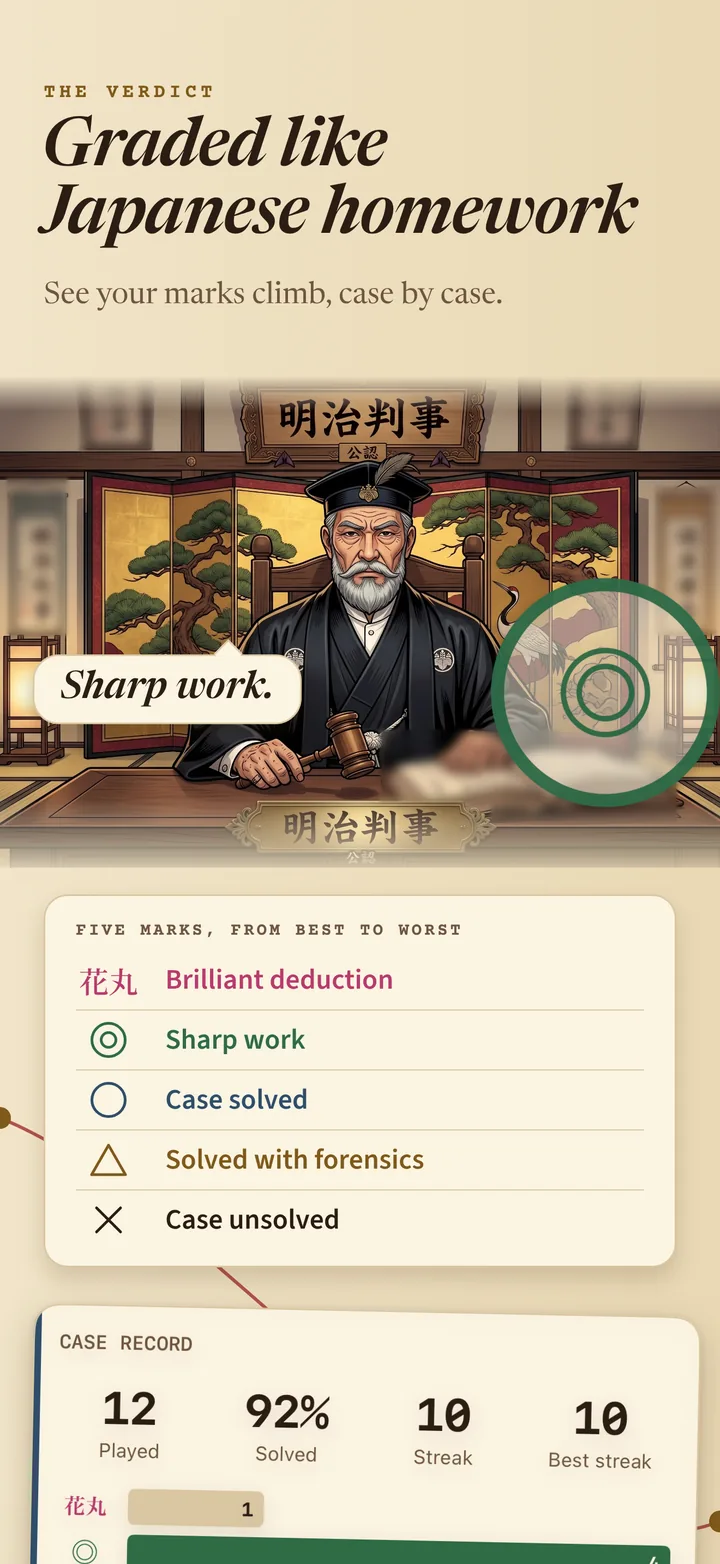
Graded like Japanese homework
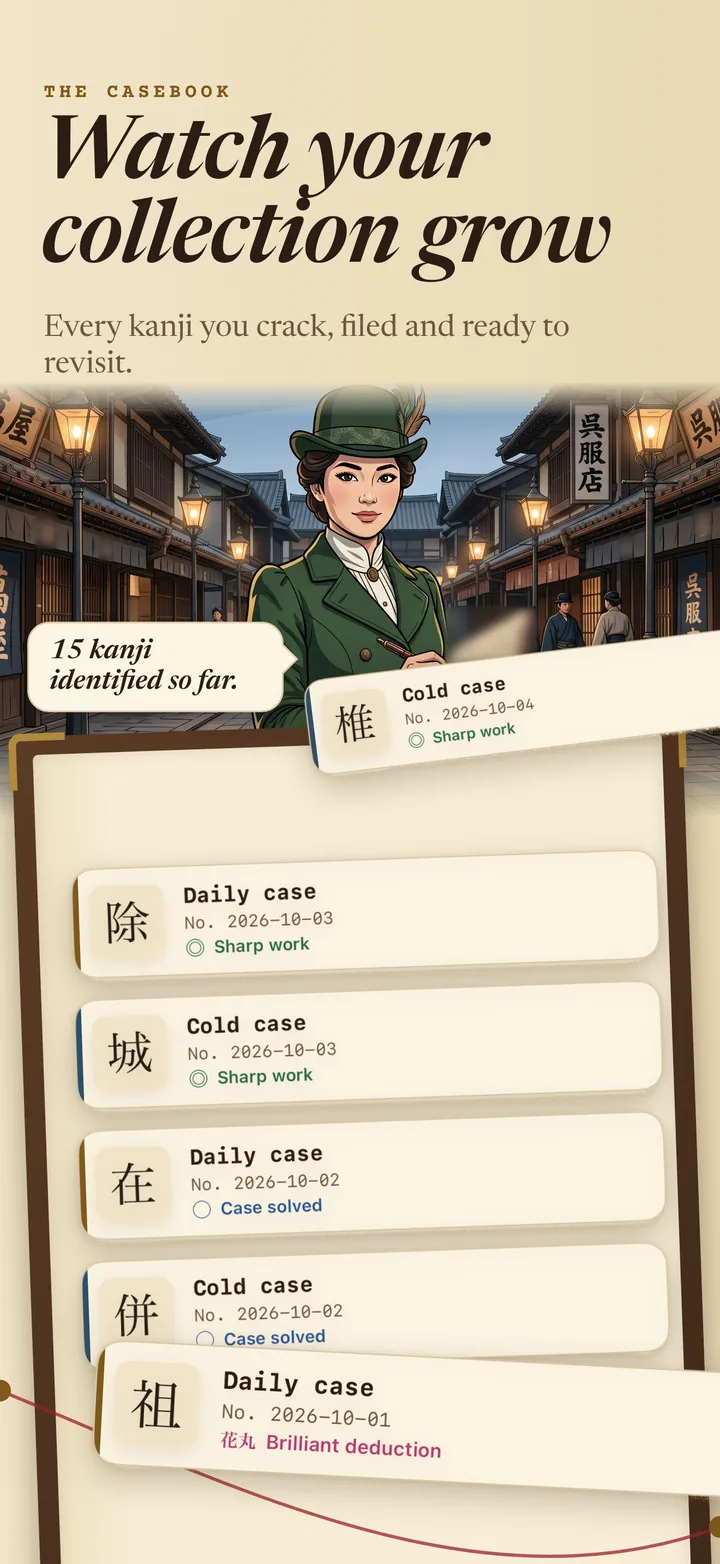
Solve with as few clues as you can. Your result is marked the way Japanese teachers mark homework — 花丸 for a brilliant deduction.
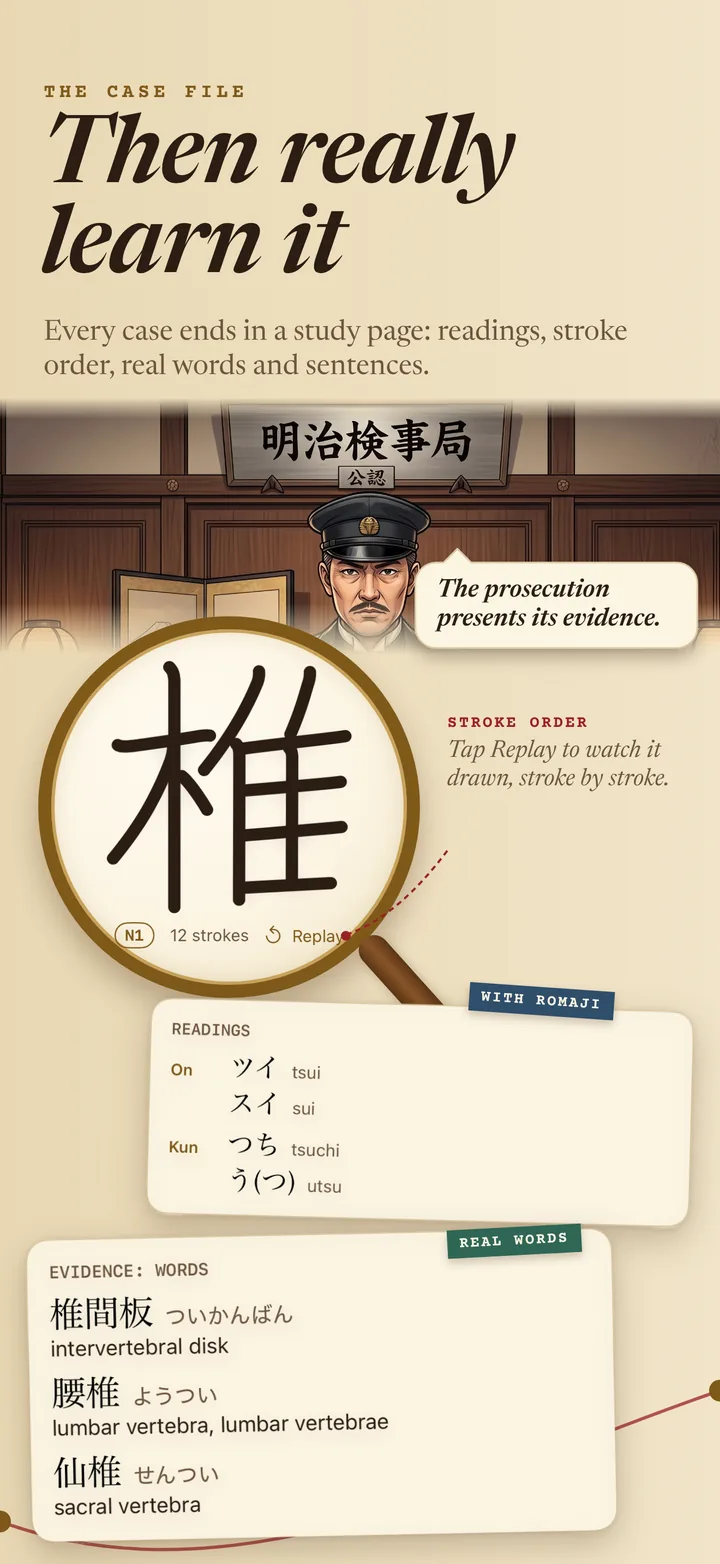
The case file
Once a case is closed, study the kanji properly: meanings, readings with romaji, animated stroke order, example words and real example sentences.
The casebook
Every kanji you crack is filed with your grade. Look back over past cases and reopen any case file to revise.
Review that comes to you
With Plus, kanji you’ve played come back for another look when they’re due: the ones that beat you the next day, the ones you nailed after two weeks.
Play in your language
Clues, meanings and example translations in English, German, French, Spanish or Korean, and you can search for a kanji by its meaning in any of them. A free guided case teaches you the ropes.
A habit that sticks
One case a day from JLPT N5–N3, Home Screen and Lock Screen widgets, an optional daily reminder and a streak saver before the case closes, streaks and statistics, and results you can share without spoiling the answer.
Private and offline
The whole dictionary is built in, so it works without a connection. No account, no ads, no tracking. Your progress syncs between your iPhone and iPad through your own iCloud account, and nowhere else.
The daily case is free. Plus is yours to keep.
Free
- A new N5–N3 case every day
- Case files, casebook and statistics
- Streaks, reminders and widgets
- iCloud sync between your devices
One-time unlock
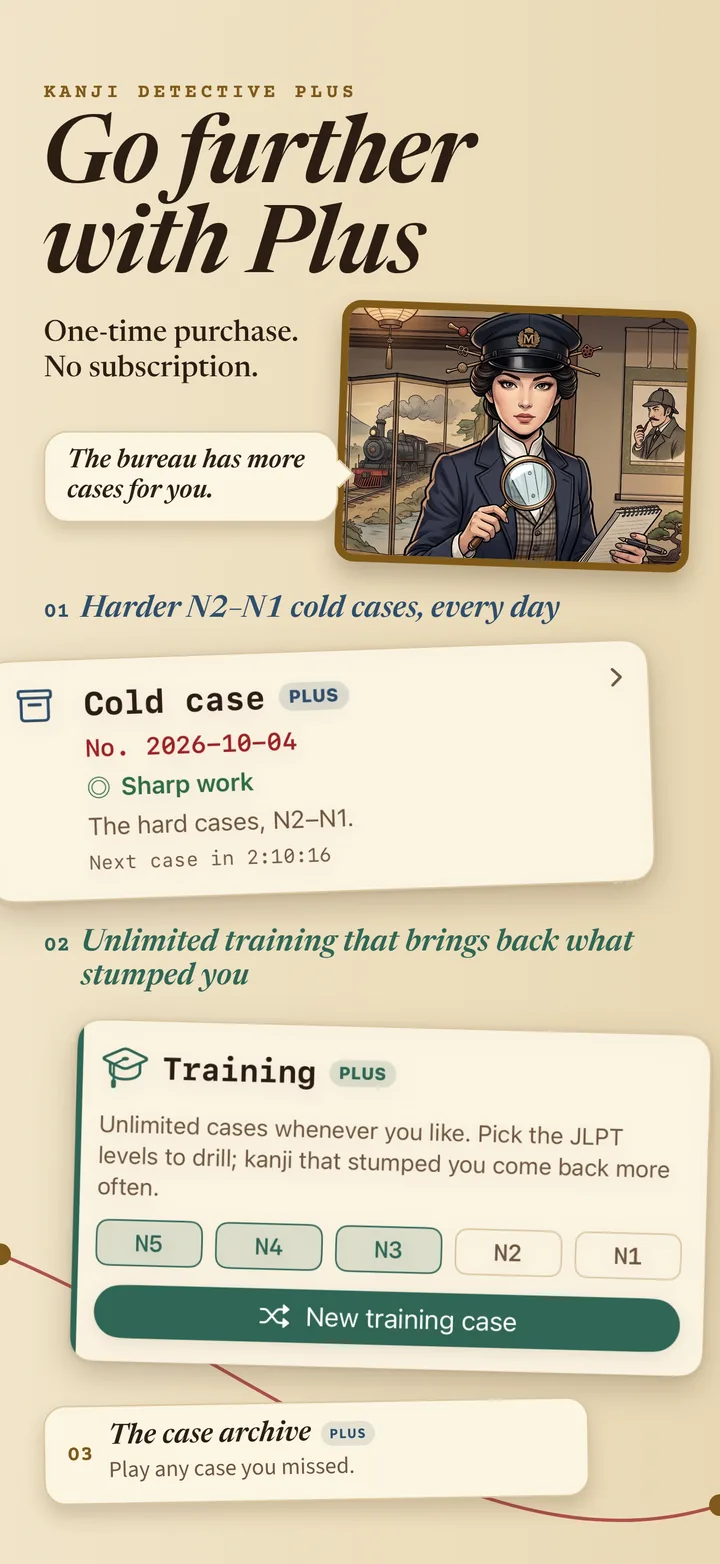
- Cold cases: a harder daily case at N2–N1
- Unlimited training at the levels you choose
- Review today: kanji you’ve played come back when they’re due
- The case archive — replay any case you missed
- Shared with your family through Family Sharing
Kanji Detective Plus is a one-time purchase. No subscription.
Download on the App StoreQuestions
Something else? See support or read the privacy policy.
What level is Kanji Detective for?
The free daily case draws from JLPT N5–N3, and most days are N3, so it suits learners who know their N5 and N4 kanji and are working towards N3. Earlier on, the clues will carry you further. Plus adds a harder N2–N1 cold case, and training at whichever levels you pick, N5 included.
Is Plus a subscription?
No — it’s a one-time purchase, and it’s shared with your family through Family Sharing.
Does everyone get the same kanji?
Yes. The daily case is the same for every detective, so you can compare results with friends. Sharing your result doesn’t reveal the answer.
Do I need an internet connection or an account?
Neither. The dictionary is built into the app. If you’re signed in to iCloud, your progress syncs between your iPhone and iPad automatically; there’s no separate account.
I missed yesterday’s case. Can I still play it?
With Plus, the case archive lets you play any daily or cold case you missed.
Will my streak follow me to a new phone or my iPad?
Yes, as long as both are signed in to the same iCloud account. Results, streaks and training sync automatically, and you can start a case on one device and finish it on the other.
I changed phones and my Plus is missing.
Tap the Cold case card or Unlock training to open the Plus screen, then tap Restore Purchases, signed in with the same Apple Account you bought it with.
A clue looks wrong. How do I tell you?
Open the case file after the case and tap Report a clue. It prepares an email with the case and the wording; nothing is sent until you send it. The German, French, Spanish and Korean clues were machine-translated, so corrections are especially welcome.
Guides & notes
- Does kanji stroke order matter? Yes, and here are the rules Stroke order can feel like something only calligraphers need. It isn’t. Here’s why it matters even if you rarely write by hand, and the handful of rules that cover most kanji.
- Kanji that look alike, and how to tell them apart 未 and 末, 土 and 士, 待 and 持. Some kanji differ by a single stroke. Here are the pairs that trip learners up most, and exactly what to look at to tell them apart.
- On’yomi and kun’yomi, and how to tell which reading a word uses Most kanji have a Chinese-derived on reading and a native Japanese kun reading. Here’s where they come from, a rule of thumb for which one a word uses, and the exceptions worth knowing.
- How to work out a kanji you don’t know from its parts Most kanji are built from smaller components that hint at their meaning or reading. Here’s how to read those clues, with examples, so unfamiliar characters stop being a wall.
- How to learn kanji for the JLPT in a few minutes a day Cramming kanji rarely sticks. Here’s a short daily routine for JLPT N5 to N3 kanji that builds recognition, readings and real usage, without hours of flashcards.
- How Kanji Detective’s clues work, and why wrong guesses help you learn Kanji Detective turns every wrong answer into a new clue. Here’s what each clue reveals, how cases are graded, and how to use the daily case to learn kanji.